Competition as an Operating System: Inside SpaceX—and Across the Market
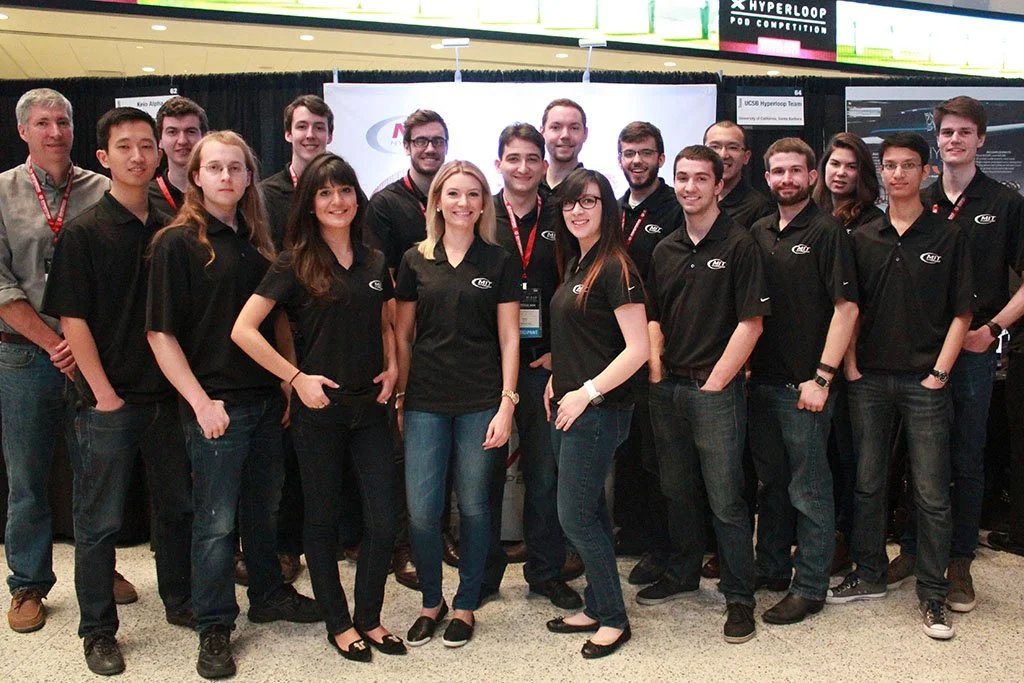
An example of how internal competition can drive innovation: in 2016, an MIT team successfully participated and won the first round of the SpaceX Hyperloop Contest to design Elon Musk's Hyperloop, a high-speed transportation concept.
Image credit: Nargis Sakhibova
Pairing internal rivalries with dual-provider procurement to improve price, resilience and pace
Space doesn’t just reward great engineering; it rewards great incentives. The fastest movers tend to combine internal contests that compress learning with market-level rivalry that disciplines price and improves reliability. SpaceX’s Texas vs. Florida Starship builds are the internal case study; NASA’s Commercial Crew and earlier JSF selection offer the market-level analogue. Together they show why structured competition raises capability and lowers cost for buyers.
Start inside the firm. Musk’s decision to run competing Starship prototypes at two sites—explicitly framed as a race—built evidence faster. Reporting at the time noted the intracompany competition and Musk argued the head-to-head would improve both design and manufacture. Your dissertation captures the same point in the literature review: internal competition as a driver of innovation when paired with visible metrics and rapid feedback. For a launch provider, that translates directly into cadence (more attempts per quarter), learning rate (fewer repeated failures), and unit economics (less rework and tighter turnaround).
Now look at external rivalry. In 2014 NASA awarded firm-fixed-price Commercial Crew contracts to Boeing and SpaceX, explicitly to create two providers and avoid a single-vendor trap. The agency’s Inspector General later estimated per-seat costs of roughly $55 million for SpaceX’s Crew Dragon and about $90 million for Boeing’s Starliner—an uncomfortable comparison that nonetheless illustrates the pricing discipline and resilience a dual-track approach can create. GAO’s oversight reports reinforced the logic: parallel providers, fixed prices, and staged certification improve bargaining power and programme robustness.
The JSF competition is a useful precedent from adjacent aerospace: Lockheed Martin’s X-35 beat the Boeing X-32 after a head-to-head fly-off on key requirements such as the STOVL regime. Whatever one thinks of the F-35 programme’s later travails, the competition phase forced rapid integration of propulsion, structures and digital engineering—and created knowledge capital that diffused through the supply chain. Space has seen similar effects in heavy-lift and crew programmes as multiple primes chase the same customer outcomes.
What should operators and investors take from this? First, internal rivalry is a controllable lever. Mirror critical workstreams—two build methods, two software control stacks, two shielding concepts—then compare like-for-like on availability, rework hours, and turnaround. Publish the conversion rule: once a branch delivers a defined delta (say, 15% faster assembly with equal fault rates), it becomes the standard across the fleet. This is effectively portfolio management inside engineering, and it keeps pet theories from surviving on charisma.
Second, external rivalry belongs in procurement design. NASA’s fixed-price, dual-provider structure is instructive: it created redundancy, enabled apples-to-apples performance comparisons, and—when one provider faltered—kept missions flying. For commercial stations, cargo, and in-space services, buyers can borrow that template: framework agreements with two vendors, common interfaces to ease switching, and outcome-based metrics (on-time berthing, cargo mass delivered, anomaly minutes) written into service levels.
The go-to-market implications are practical. Teams that prove outcomes under competitive pressure—internally or in head-to-heads—sell availability and throughput, not just hardware. They package integrations, spares pools, and observability from day one, because those are the levers that win comparative bake-offs. On the finance side, evidence from dual-provider programmes makes cashflows more believable: underwriters can see how competition protects service continuity and restrains price escalation over multi-year horizons.
Finally, there’s a national-industrial angle. Agencies and sovereign buyers concerned with resilience can adopt multi-track development (two architectures advancing in parallel) and then down-select with open artefacts—test data, interface standards, post-mortems—that the wider ecosystem can reuse. That’s how competition becomes an operating system, not just an event: it builds capability, transparency and talent that compound across firms and programmes.
If you want more innovation per pound in space, do what works at both levels. Inside, let teams race—with shared dashboards and explicit conversion gates. Outside, write competitions and contracts that pay for outcomes and keep more than one pathway alive. The result is faster learning, lower cost, and services that customers can trust.