Inside The Moon: Roads, Rails, And Hoppers For Intra-Lunar Logistics
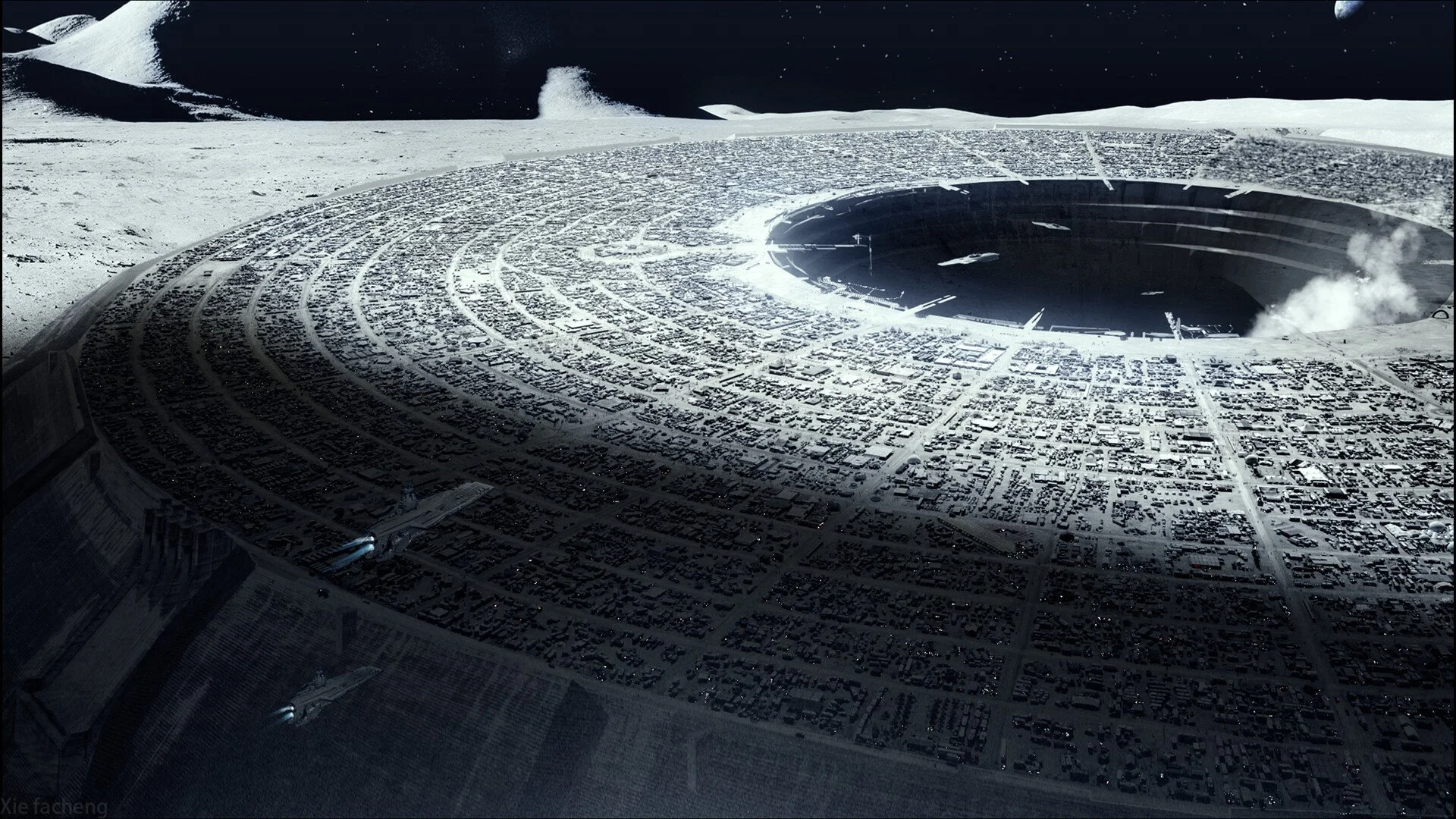
Concept art of a futuristic Moon city with advanced infrastructure, built within a natural basin of a lunar crater. While this may appear fantastic, it is a realistic possibility in the coming centuries.
Image credit: Fafa! on ArtStation
How movement choices shape cost, safety and cadence
Moving people and cargo on the Moon will not be a single-vehicle story. Terrain changes quickly from compacted regolith to slopes of loose fines; radiation and temperatures argue for less time in suits; dust threatens seals, optics and lungs. The result is a mixed toolkit. Three modes—paved corridors, fixed-guideway rail, and ballistic or propulsive hoppers—cover different ranges and payloads, with power and dust control as common threads.
Roads, but made of Moon
Unpaved traverses throw dust and erode hardware; paving is therefore an enabling investment, not a luxury. Recent European work has demonstrated laser-sintering of regolith simulant into interlocking “bricks” and continuous strips, aiming at dust-suppressing roads and pads that can be made in situ. The concept trades time and power for reduction in maintenance and contamination—a sensible swap as traffic grows. ESA’s summary links to a 2023 Scientific Reports paper that tested large-area laser melting and discussed thickness and throughput parameters, indicating a practical path to graded, consolidated lanes around early bases.
Rails as dust-light freight
Where routes are predictable—plant to depot, depot to portal—rail earns a look. A 2024 study from Northrop Grumman examined a modular lunar rail network linking polar work sites, noting lower dust generation than wheeled rovers and the potential to span tens of kilometres initially, with hundreds later. The paper highlights the real engineering unknowns (soil modulus, track deflection, the energy cost of sintering track beds) but frames rail as a scalable backbone once sites stabilise and volumes justify fixed guideways. In economic terms, rail converts variable traverse risk into predictable slots, which matters for high-value cargo and scheduled operations.
Hoppers for the places wheels shouldn’t go
For craters, scarps, or discontinuous terrain, propulsive or ballistic hoppers avoid the very thing that defeats wheels: the ground. The idea is old—NASA-funded work on hopping transporters dates to the Apollo era—and is now re-emerging in flight hardware. Intuitive Machines’ Micro-Nova Hopper is designed to deploy from a lander and “hop” among targets, extending reach into permanently shadowed regions (PSRs) that may host water ice—useful precursors for later human logistics. Hoppers are not bulk haulers; they are access multipliers for scouting, inspection and sample return in terrain that punishes wheels.
Mobility as part of the safety case
Time in shirtsleeves matters. The pressurised rover programmes (for example, the JAXA/Toyota “Lunar Cruiser”) treat mobility as a mobile room, supporting multi-day sorties and acting as a refuge and clinic on wheels. In a networked estate, paved loops near base, short rail spurs to key assets, and hopper sorties to PSRs combine to reduce suit hours, cut dust exposure, and keep maintenance in controlled environments.
Power and thermal set the tempo
All three modes are power-hungry. Roads demand energy for sintering; rail needs generation for traction and points; hoppers burn propellant with care. This is why baseload power appears in every serious lunar architecture. NASA’s Fission Surface Power (FSP) programme targets ~40 kWe class systems for a first lunar demonstration, explicitly to decouple operations from the day–night cycle. A logistics network that can run at night and in shadow—paving, shunting, or scouting—depends on that kind of steady supply.
Dust is the common enemy
Apollo experience documented abrasion, fouling and visibility hazards from lofted dust; NASA’s more recent technical briefs and risk assessments underline respiratory and ocular concerns as well as damage to mechanisms and seals. Roads and rails reduce plume and tyre-thrown dust near bases; hoppers reduce rolling contact in fragile terrain; airlocks and service bays localise contamination. The logistics choice is therefore also an occupational-health choice.
How a portfolio might phase in
Early missions rely on unpaved traverses and limited pad paving to contain dust at landing and loading points. As traffic grows, ring roads of sintered regolith link habitat, power and storage, with short rail spurs to predictable flows (for example, ice-processing plants to tanks). Hoppers remain the tool for inspection, survey and light deliveries in PSRs and rough terrain, with lessons feeding eventual human access plans. The mix shifts with use: more rail as routes settle; more paving as dust costs accumulate; continued hopper sorties where geology or shadow dictate.
Commercial and operational implications
The economic logic follows throughput. Sintered roads are capex-heavy but reduce opex on vehicles and suits. Rail offers attractive unit costs at volume and protects sensitive payloads from dust and shocks. Hoppers create option value—the ability to reach difficult targets on short notice—which is a strategic benefit when a single find (for example, a new ice patch) changes the plan. Across all modes, cadence—predictable movement, day after day—will determine whether lunar industry moves beyond experiments to routine operations. The winning estates will be the ones that treat mobility as infrastructure, not as an afterthought—integrating power, pads, guideways and vehicles into one service.