From Tunnel Boring To ‘Lunar Cruisers’: Earth Tech We Can Port To The Moon
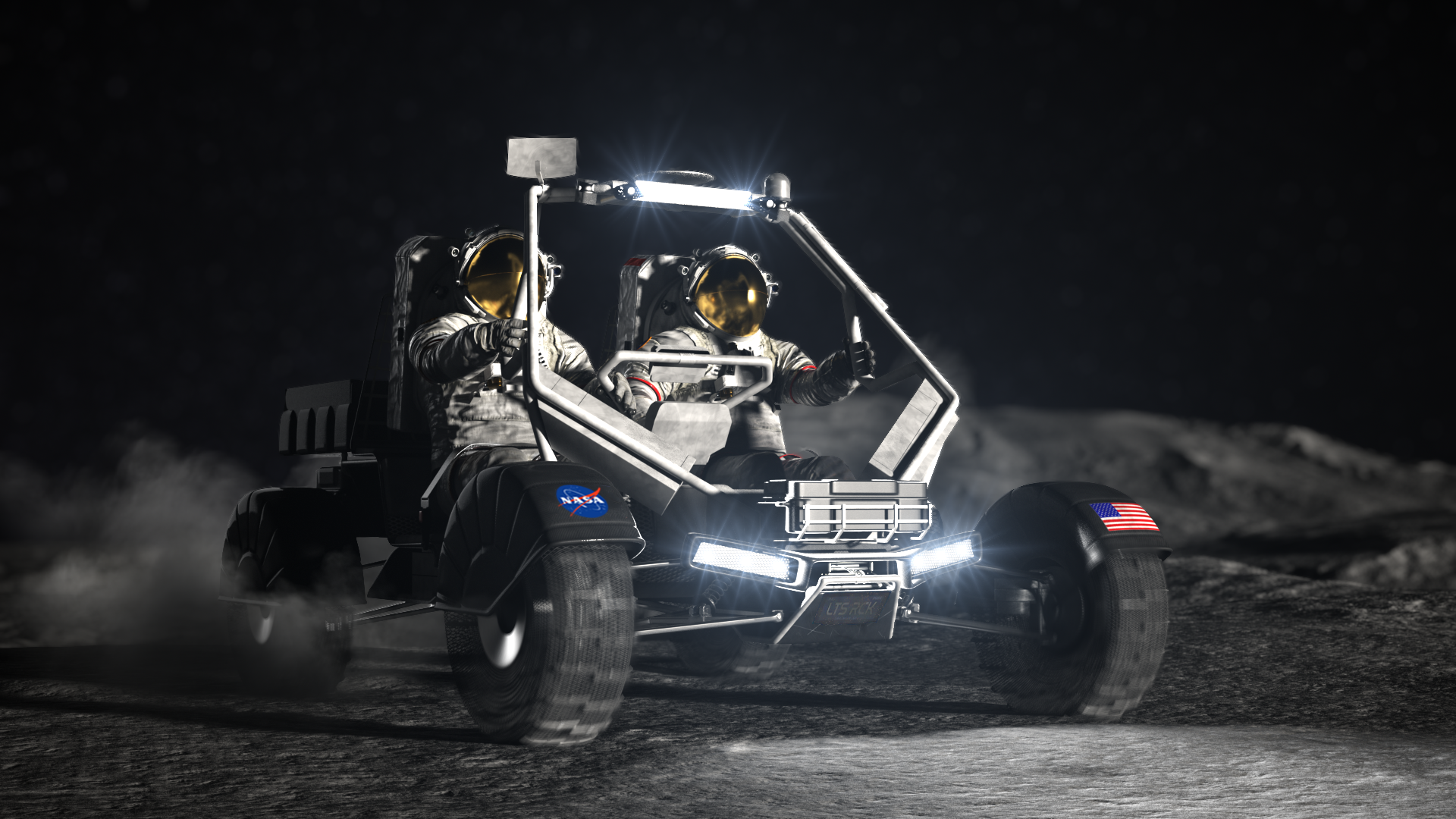
Concept art for NASA’s Lunar Terrain Vehicle (LTV), which is part of the Artemis campaign to explore the Moon.
Image credit: NASA
Power, mobility, construction and medical systems that already exist—and how Artemis and allied programmes stitch them together
If living “on or under” the Moon is a safety trade, the enabling toolkit is increasingly familiar. Much of what early lunar bases need—baseload power, sealed mobility, modular habitats, subsurface survey and lining, dust-tolerant automation—has close cousins on Earth. The question is what travels well, and how current space programmes intend to integrate it.
Baseload power you can bank on
Surviving the two-week night at many latitudes or running equipment in caves implies dependable power rather than opportunistic sunlight. NASA and the U.S. Department of Energy’s Fission Surface Power (FSP) effort targets a ~40-kWe reactor for a lunar technology demonstration, explicitly to decouple operations from daylight and to support industrial-scale work. NASA Glenn’s 2024 workshop framing and the agency’s programme page set out the rationale—compact, 10-year systems with transportable components—and confirm active maturation toward a lunar demo timeline. Idaho National Laboratory materials further describe design assumptions and test campaigns aimed at space-qualified controls, fuels and heat rejection. Together they anchor baseload power as a near-term import rather than a distant aspiration.
Mobility as a “mobile room,” not a buggy
Exploration range and safety margins widen with pressurised rovers that function as shirtsleeve environments. Under a long-running partnership, JAXA and Toyota are developing the Lunar Cruiser, a crewed pressurised rover that builds on fuel-cell and EV experience. Toyota’s public programme pages and news releases outline the vehicle’s role—multi-day sorties, contingency shelter, and logistics support—while recent coverage details mission profiles and supply loads for two-person crews. In Artemis planning documents, a pressurised rover sits alongside the unpressurised Lunar Terrain Vehicle (LTV), a surface habitat and power systems as core Base Camp elements. The through-line is clear: mobility for days, not hours, is being treated as foundational, with an Earth automotive supply chain adapting to lunar constraints.
Habitats and interior systems: modular, shielded, serviceable.
On Earth, high-reliability environments—submarines, Antarctic stations, sealed labs—show how living, work and maintenance functions can be layered in compact volumes. Artemis-era studies of a Foundation Surface Habitat echo that pattern: a hub for comms, EVA servicing, waste handling, science work and crew support, designed to be bermed with regolith for radiation protection. While popular media add colour to interior layouts, the underlying NASA technical papers emphasise repairability, segregated “dirty” and “clean” zones, and circulation that reduces dust intrusion—pragmatism rather than theatrics.
Subsurface civil methods, adapted
If subsurface districts become attractive for dose and temperature, Earth civil playbooks—survey, stabilise, line, drain—provide a start. The science case for lunar lava tubes is strengthening: analyses suggest spans from hundreds of metres to kilometre-class features could be structurally stable, given low gravity and basaltic roofs. European fieldwork and reviews translate that into deployment questions: mapping with ground-penetrating radar and autonomous scouts; lining or shotcrete analogues to control spall and dust; and entrance works that tolerate thermal cycling. The direction of travel is toward scalable voids, tempered by logistics at the portal and the need for robust comms back to the surface.
Dust-tolerant automation and maintenance
Lunar dust is abrasive and electrostatically clingy; Earth industries that cope with silica, ash and alkali environments point to design patterns that port: labyrinth seals, positive-pressure enclosures, sacrificial wear parts and remoteable maintenance. Artemis hardware pairs these with pressurised mobility to keep humans out of suit cycles whenever possible—again reflecting how Earth industrial safety thinking migrates to the Moon.
Programme stitching: how the pieces come together
Artemis provides the first integration canvas. NASA’s planning and technical literature present a surface-first stack: LTV for local tasks, pressurised rover for range and refuge, a surface habitat that can be shielded, and FSP (plus solar and storage) for power continuity. The architecture is intentionally modular; each element adds value on its own and compounds when combined—mobility de-risks site selection; baseload power lifts constraints on life-support and manufacturing; habitats serve as service hubs rather than static monuments.
Parallel roadmaps: where partners converge and diverge
Beyond the Artemis coalition, the International Lunar Research Station (ILRS) led by China and Russia sketches a south-polar network of nodes through the 2030s. Recent reporting from space agencies and media indicates a plan that includes nuclear power to provide steady energy, with phased deployment toward a permanent base. The governance models differ—Artemis Accords versus ILRS MoUs—but the technological themes rhyme: baseload power, autonomous construction, and polar siting for logistics and sunlight. Reading both programmes together suggests a common equipment ledger, even if political umbrellas are distinct.
Healthcare and “ops medicine”
Earth telemedicine, remote diagnostics and compact surgical suites can be adapted for the Moon, with the habitat acting as a stabilisation and minor-procedure unit. The practical import is reduced evacuation dependency: with baseload power and sealed mobility, medical response windows expand from hours to days, shifting risk profiles for further-afield sorties.
What ports cleanly—and what does not
Power systems with mature terrestrial analogues (fission, grid-like distribution, heat rejection) and vehicles from an automotive supply chain (pressurised rovers) are the most transferable. Civil methods transfer at the principle level but require new tooling for low gravity and dust, particularly at cave portals. What transfers least well are assumptions about rapid rescue: communications, evacuation and spares pools must be sized for distance and delay.
Implications for a mixed-estate Moon
Taken together, the near-term picture is pragmatic. Surface hubs—anchored by dependable power and mobile rooms—make month-scale campaigns routine and support the early industrial tasks (pads, berms, prospecting, tests). Subsurface volumes—accessed via prepared portals—become attractive as stays lengthen, dose budgets tighten and scientific activity grows. Across both, the Earth-to-Moon transfer is less about breakthrough invention than disciplined adaptation: certify the power plant; build the rover with life-critical systems first; design habitats as serviceable machines; treat caves as civil-works projects, not cinematic refuges.
The virtue of this approach is compounding readiness. Each component—FSP, Lunar Cruiser, surface habitat, lava-tube survey and lining—stands on its own, lowers mission risk, and connects to a larger operational picture. Artemis is explicit about that modularity; allied and parallel programmes reach for the same levers. If permanence is the goal, the shortest path is to move proven Earth systems into lunar context and let operational learning, rather than architectural romance, set the tempo.