Living On The Moon: Surface Outposts Versus Subsurface Shelters
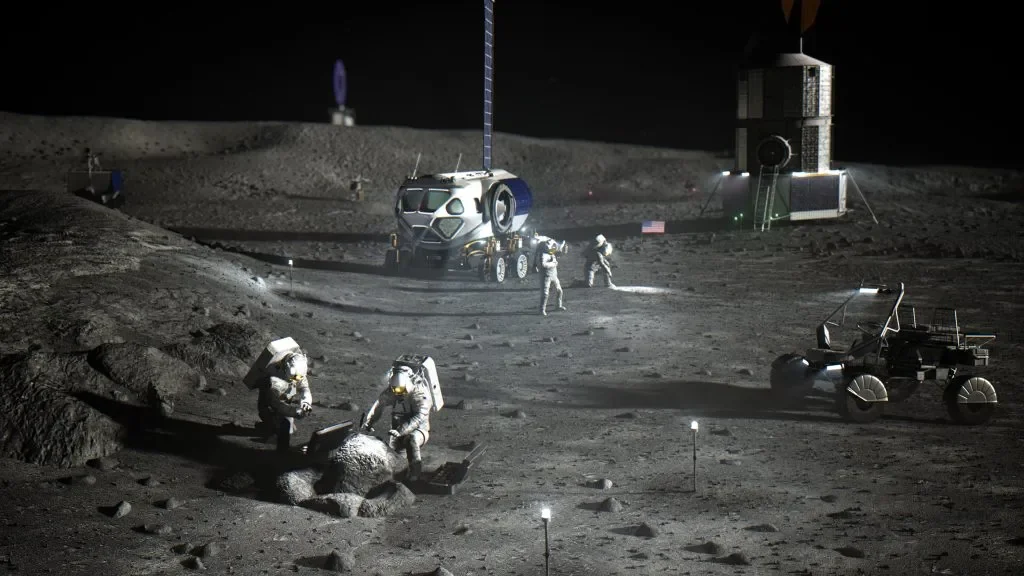
Illustrative art showing astronauts on the lunar South Pole, as part of NASA’s Artemis Base Camp Concept.
Image credit: NASA
What physics, radiation, dust and power say about safety—and where Artemis actually points
The question of “on or under” the lunar surface is not aesthetic; it is a trade between dose budgets, dust, thermal stability and operational complexity. In the near term, programme roadmaps suggest surface-first architectures with heavy shielding and mobile habitats; over longer horizons, subsurface options become attractive as mission durations grow and cumulative radiation risk dominates. NASA’s Artemis Base Camp concept is a useful anchor: a surface habitat, unpressurised and pressurised rovers, and robust power to survive day–night cycles.
Hazard baseline. The Moon offers no global magnetic field or thick atmosphere; crews face galactic cosmic rays (GCRs), solar particle events, micrometeoroids and extreme thermal swings. NASA notes equatorial surface temperatures that can exceed 121 °C by day and plunge to −133 °C at night, with two weeks of darkness at many latitudes—conditions that drive power and thermal design before comfort. Dose-depth curves from recent NASA presentations reinforce that thick regolith shielding materially reduces GCR risk for multi-mission stays, placing a premium on mass-efficient protection strategies.
Surface habitats with shielding. Artemis planning documents envision a “foundation surface habitat” augmented by regolith berms and pressurised mobility to reduce EVA exposure and extend reach. The pressurised rover is effectively a mobile room: it provides shirtsleeve environments for exploration sorties measured in days rather than hours, with Japan now formally leading design, development and operations under a 2024 U.S.–Japan agreement. NASA’s public rover brief and Toyota/JAXA programme materials frame this vehicle as central to early surface operations, including contingency shelter and crew return across longer traverses.
Radiation mitigation on the surface. A key lever is local shielding. Peer-reviewed work and space-weather assessments point to regolith as a credible attenuator when used at sufficient areal density; recent analyses quantify protection levels across solar events and GCR spectra, informing berm thickness and interior layout. Where hydrogenous materials are available (for example, water-derived products at polar sites), layered shields can further improve dose performance. The implication is pragmatic: for 30–60-day campaigns, surface modules with engineered shielding can meet dose objectives; for multi-year presence, the mass and complexity of shielding become first-order drivers of the site plan.
Subsurface options: lava tubes as natural bunkers. The counter-proposal is to go under—into lunar lava tubes or skylight-linked caves. ESA and academic studies highlight three advantages: (1) radiation attenuation from metres of overburden; (2) thermal stability with temperatures far steadier than the surface; and (3) scale—modelling suggests spans of hundreds of metres may be structurally stable, creating volumes large enough for grouped habitats and laboratories. The trade-offs are practical: uncertain access points, the need for detailed mapping and lining, dust control in confined spaces, communications links to the surface, and emergency egress plans that do not exist in current playbooks.
Dust and operations. Lunar dust is electrostatically clingy and abrasive, with implications for seals, mechanisms and crew health. Subsurface locations reduce direct exposure to lofted dust during surface storms and vehicle operations, but they introduce egress/ingress choke points that concentrate wear and contamination. By contrast, surface camps can distribute operations across multiple airlocks and bermed pads—useful for keeping fouling away from life-support interfaces. This is not a binary win; it is a question of where dust is managed, not eliminated. (Artemis logistics assumptions around bermed pads and dedicated approach corridors reflect this.)
Power as the organising constraint. Surviving the 14-day night at many latitudes, or operating equipment in caves, pulls the design toward baseload power. NASA and the U.S. Department of Energy’s Fission Surface Power (FSP) programme targets a ~40 kWe class reactor for a lunar demonstration as early as the end of this decade, explicitly to reduce dependence on sunlight and to enable industrial-scale work. NASA Glenn’s 2024 update and INL’s programme brief underscore that fission is being treated as a cornerstone for sustained presence, complementary to polar solar arrays and energy storage. For subsurface estates, fixed baseload plus local distribution is the difference between “survivable” and “productive.”
Mobility as safety margin. The pressurised rover acts as a range-expander and a risk-reducer regardless of habitat choice. It enables exploration without repeated prebreathing and suit cycling, doubles as a mobile refuge, and provides a platform for cave-entrance reconnaissance before committing fixed assets underground. JAXA and Toyota’s public updates through 2025 point to sustained prototyping and field trials as part of an international stack that supports Artemis sorties.
Where Artemis actually points. Artemis documentation and public briefings present a surface-first arc: demonstrate crewed sorties, stand up a surface habitat with shielding, field unpressurised and pressurised rovers, and add power that decouples operations from day–night cycles. Subsurface exploration sits on the roadmap as a phase-in option as durations increase and as mapping/lining technologies mature. In parallel, other national programmes—most notably the International Lunar Research Station (ILRS) proposed by China and Russia—describe surface power and autonomous infrastructure at the south pole, with recent reporting pointing to a potential nuclear power plant in later phases. The trajectories differ in governance; the technology themes (baseload power, mobility, shielding) converge.
So—on or under? For early missions measured in weeks to months, surface habitats with engineered shielding, bermed pads and robust mobility provide a straightforward safety case and simpler logistics. As operations extend to years, cumulative radiation exposure, thermal stability and dust control tilt the ledger toward subsurface districts—likely accessed via prepared portals and equipped with lined, pressurised volumes tied to surface power and comms. In practice, mature lunar settlements look mixed-estate: surface hubs for power, logistics and transport interfaces; subsurface zones for living quarters, labs and any activities most sensitive to radiation and temperature.
The underlying message is consistent across programmes: permanence depends less on architectural imagery and more on power you can bank on, shielding you can prove, and mobility that reduces exposure. Artemis provides the first rung—surface infrastructure and mobile habitats that make month-scale campaigns routine. Subsurface capability becomes the next rung when dose budgets and productivity demand it, drawing on Earth-proven civil methods adapted to low gravity and pervasive dust. That sequence does not pre-judge the destination; it reflects the physics and the programme evidence in hand.