Policy to Product: Zero-Debris Rules Are Creating ADR Demand Signals
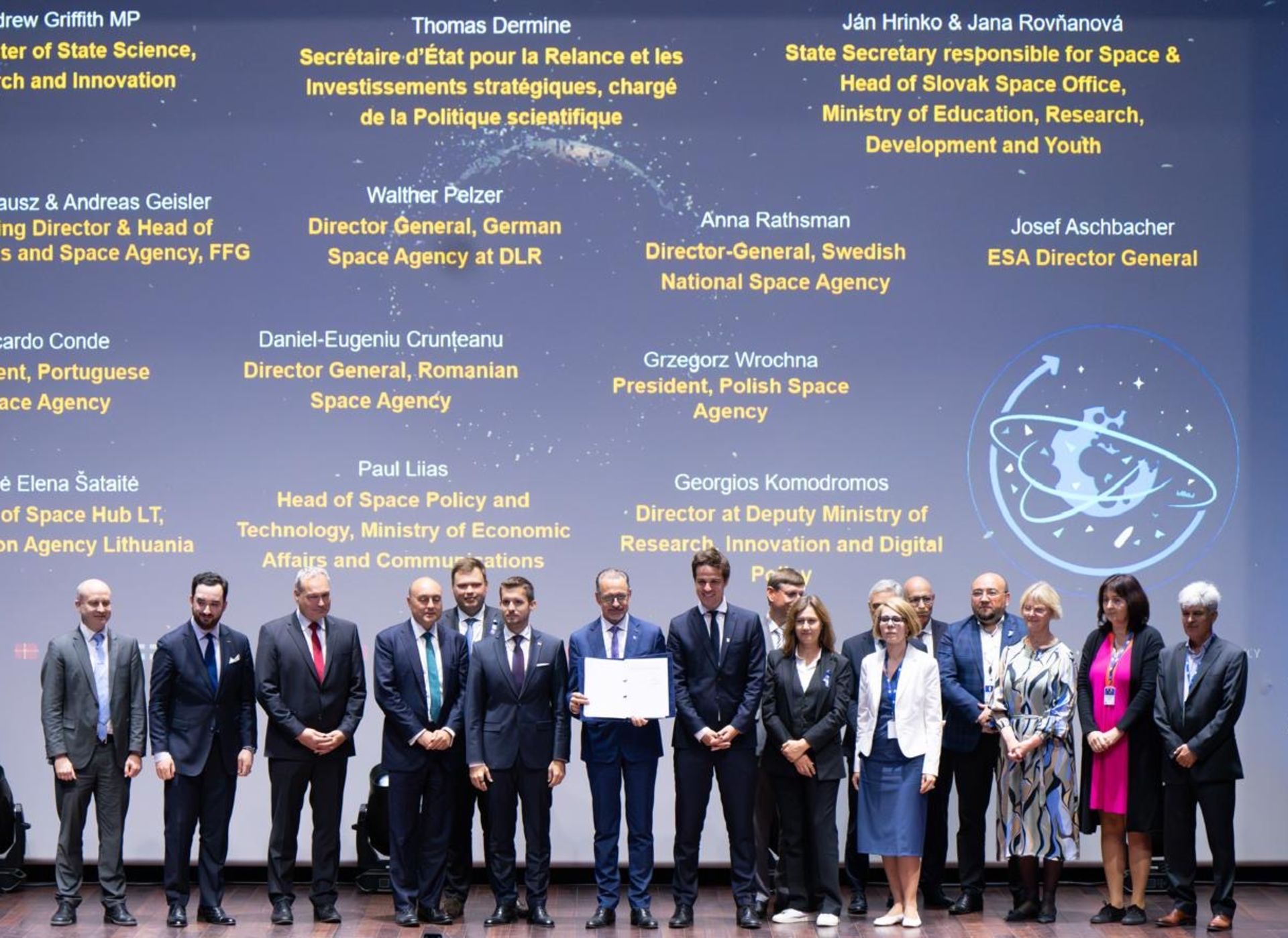
12 nations signed the Zero Debris Charter at the ESA/EU Space Council in May 2025. This marks a powerful commitment to sustaining human activities safely in Earth orbit.
Credit: ESA
ESA’s charter, the FCC’s 5-year disposal rule and UK insurance reforms are turning sustainability into contracts
For years, “space sustainability” sounded like a poster. Now it reads like procurement. Three levers are converging to monetise clean operations: Europe’s Zero Debris Charter, the US FCC’s 5-year de-orbit rule in LEO, and the UK’s push to align liability/insurance with good orbital behaviour. Together they are turning corporate ESG slides into concrete budgets for servicing, design-for-demise and debris removal.
Start with Europe. ESA’s Zero Debris Charter—launched in late 2023 and expanded through 2024—has both states and industry committing to debris-neutral missions by 2030. ESA has published the growing list of signatories, including major primes and constellation operators, signalling that sustainability is becoming a qualification criterion in competitions, not a nice-to-have. That dovetails with ESA’s annual Space Environment Report, which frames risk and compliance trends with data rather than sentiment.
In the US, the FCC adopted the “5-year rule”: LEO satellites licensed by the Commission must be disposed of within five years of mission end, a sharp tightening from the long-standing 25-year guideline. For operators active in the US market—even if they’re not US companies—this becomes a hard schedule constraint that must be reflected in design and operations (propellant budgeting, drag-augmentation sails, or contracting third-party EOL removal).
The UK is leaning into economics. In 2024, government consulted on orbital liabilities, insurance, charging and space sustainability, exploring how licence terms, premiums and fees might reward cleaner behaviours and price externalities from poor disposal practices. Even before new rules take effect, the direction of travel is clear to boards: ignore sustainability, pay more to fly.
For vendors, this policy stack is a demand engine. Buyers now need: (1) compliance-ready design kits (e.g., docking plates, grappling fixtures, design-for-demise components); (2) services that make compliance easy (life-extension, EOL removal, ADR); and (3) paperwork that travels—safety cases, spectra of conjunction-avoidance performance, and environmental templates regulators recognise. Offerings framed in those terms feel like risk transfer, not science projects.
A credible commercial posture looks like this. Describe the service catalogue in regulatory outcomes (“meets FCC 5-year with X months buffer,” “aligns to Zero Debris Charter principles”). Price against events (successful re-entry confirmation, perigee-drop milestones), not just time and materials. Publish mission logs that feed customers’ annual sustainability reporting—conjunction-avoidance stats, disposal success ratios, anomaly deltas—because many operators now need to show auditors and investors what “good orbit hygiene” looks like.
Insurers are paying attention. As loss data accumulates and standards firm up, premiums will start to discriminate in favour of prepared-for-removal spacecraft and operators with proven conjunction-management. Vendors who embed independent test witnessing and transparent post-mortems into their offer will find cover easier to secure and cheaper to pass through to clients.
The commercial takeaway is simple: policy has moved from pledge to purchase order. Vendors who translate charters and rules into packaged compliance—with outcomes, artefacts and service levels—will win early and often, because they make “doing the right thing” the least-friction buy on a customer’s list.